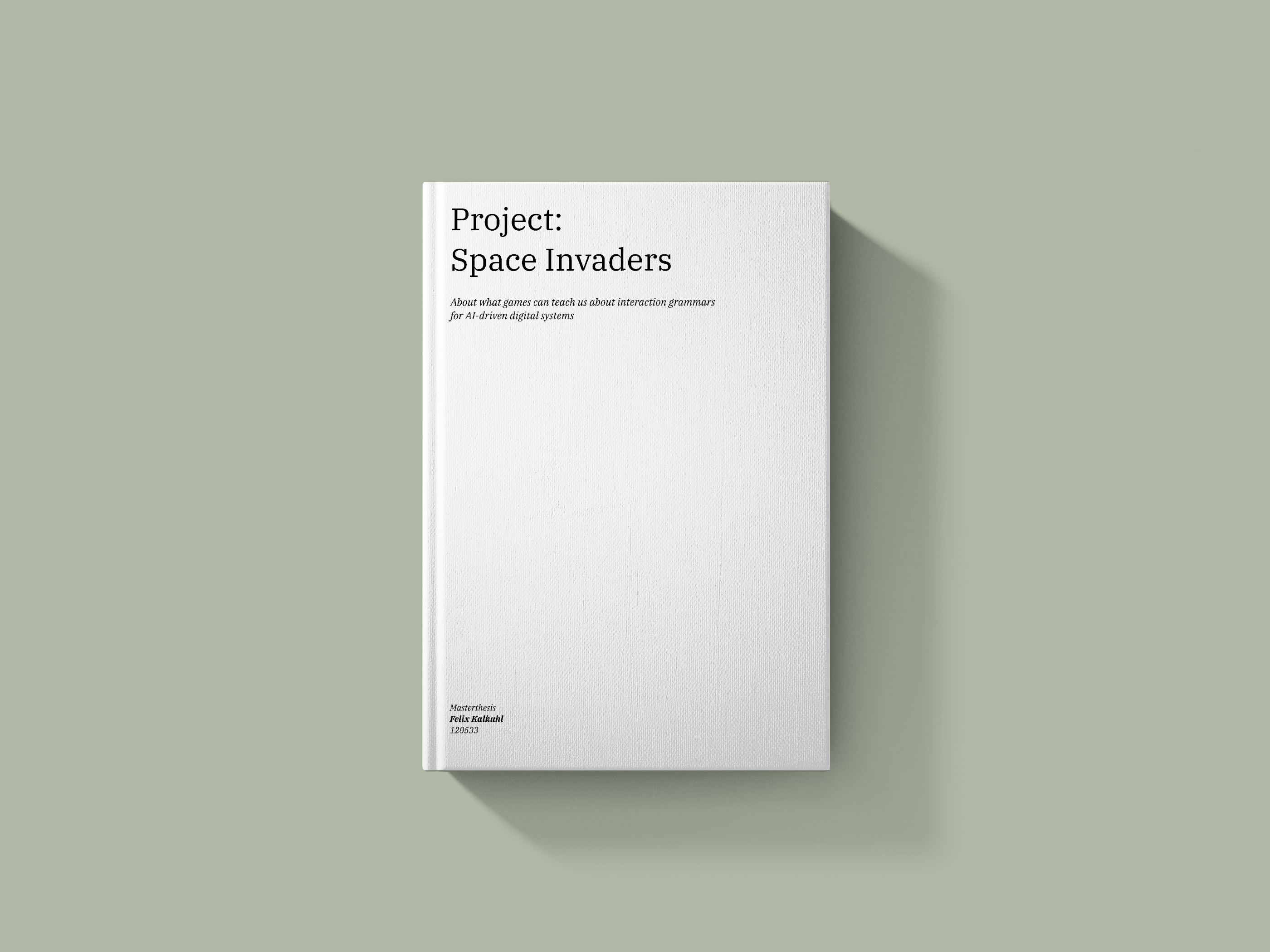
As a theoretical work, this project explores a new interaction grammar for AI systems. Using a "Research through Design" method, prototypes investigate how game mechanics improve interfaces.
A Theoretical Foundation for the AI Era
Artificial Intelligence (AI) is not a conventional tool, but a fundamentally new, probabilistic material. Nevertheless, we currently force this technology into rigid user interfaces like text chat windows. This leads to the so-called "articulation barrier": users have a goal in mind but fail to translate it into exact textual commands. This Master's thesis is at its core a theoretical work that develops a conceptual framework—a completely new "interaction grammar"—for such AI systems.
The Theoretical Approach: Video Games as a Model
To build this theory, the thesis analyzes a medium that has masterfully handled complex and unpredictable systems for decades: video games. Games preserve player agency through immediate, tangible feedback and spatial orientation. The goal of this theoretical investigation is to systematically transfer these ludic principles to AI software.
The Methodology: "Research through Design" (RtD)
To test and refine the proposed theories, the thesis applies the "Research through Design" (RtD) methodology. The designed applications are therefore not market-ready products, but experimental research instruments (Design Probes). They illustrate the theory using three core examples:
1. Media Discovery:
Instead of finding movies via search bars, users navigate freely on an interactive map between moods (e.g., gritty to high adrenaline) to bypass the articulation barrier.
2. Trip Planning (Logistics):
Time blocks behave like physical objects. If a user tries to squeeze too many appointments into a gap, the blocks visibly clash—making errors immediately tangible in the spirit of "constructive failure".
3. Roadmap Management:
The division of labor is visualized as an active network. If a manager distributes too many tasks, a visible "bottleneck" emerges, making the system's logic and consequences immediately understandable.
Target Audience and Benefits
The thesis is aimed at interaction designers, software developers, and researchers in the field of Human-Computer Interaction (HCI). Its added value is twofold: on a theoretical level, it defines AI as a new material and provides a grammar for designing with it. On a design level, it uses the RtD method to show how interfaces can once again provide visual and tangible feedback, giving users back control and trust in autonomous systems.